A dome
A geometry. The entire structure, connections, openings, foundation and site govern performance. The silhouette does not identify a binder or confer a hazard rating.
THE RESEARCH NOTEBOOK / REVIEWED 16 SEPTEMBER 2026
Rock Protects Rock
Exploring geopolymer homes that could protect people and reduce our impact on Earth.
What exists now? Where can it be built? What could become better?
Download the illustrated research companion ↓Dome, geopolymer and bioceramic describe different things.
A geometry. The entire structure, connections, openings, foundation and site govern performance. The silhouette does not identify a binder or confer a hazard rating.
A family of mineral binders. Precursors, activators, aggregates and curing can change the result. Many alkali-activated concretes have different chemistry and properties. Material research.
Geoship describes a magnesium phosphate system. Its proprietary ceramic is not interchangeable with every aluminosilicate geopolymer. Company description.
Strength, toughness, heat resistance, insulation and moisture control are separate properties. A promising binder still needs a working building assembly.
CURRENT OFFERINGS
Four examples with different scopes.
Named for research, without endorsement or affiliation.
A home offering
Initial offer: Northern California, USA
Materials. The company describes a proprietary magnesium phosphate ceramic, a different chemistry from many aluminosilicate geopolymers. The home also needs insulation, windows, seals, ventilation, services and a foundation. A complete current bill of materials was not verified.
What it opens upAn integrated mineral-shell home offering brings material innovation into residential construction.
Trade-offs to investigateEmerging delivery base and restricted launch geography; proprietary formulation. Long service life, all-hazard performance and full environmental benefits need independent evidence with a defined scope.
Advertised US$300/ft² × 1,643 gross ft² is about US$492,900 as arithmetic context. Land and foundation/utilities/site work are separate scope. This is not a contractor quote or an affordability claim. Insulation R-32 and airtightness values are published targets.
The company reports California factory-built housing certification. Its actual certificate and conditions were not independently verified here; local site permission remains separate.
Current model ↗ · Advertised offering ↗ · Company chemistry and reported tests ↗
A building system
US-based system with completed projects
Materials. Inflated Airform, polyurethane insulation, steel reinforcement and sprayed concrete. Geopolymer binder is not the default description.
What it opens upA longer history of completed buildings provides practical examples to study, including the reported Tinsley home case.
Trade-offs to investigateConcrete, steel and foam all contribute impacts. Specialised construction, openings, maintenance and end-of-life separation deserve attention. One surviving home does not establish a universal hazard rating.
Project-specific design and construction pricing. No comparable turnkey quote was verified.
Engineered plans and the applicable local approval process remain necessary.
Commercial concrete material
Documented Australian residential use; supply is location-specific
Materials. Slag and pulverised fly ash, chemically activated to replace the Portland-cement binder. Aggregate and other mix constituents remain part of the concrete.
What it opens upReported use of over 117 m³ in a Brisbane residential renovation shows an alkali-activated material reaching construction.
Trade-offs to investigateFeedstock variability, activator impacts, curing, transport and exposure-specific durability affect outcomes. A concrete supply does not include a dome design or a house permit.
Obtain a local mix and placement quote. No globally applicable installed-home price exists.
Assess the supplied mix, its intended structural use and the complete project.
Material technology for producers
Manufacturing partners and licensed applications
Materials. Alkali-activated material technology using industrial mineral side streams and activators. Formulations and intended products vary.
What it opens upLocal feedstock development can widen material research and manufacturing possibilities.
Trade-offs to investigateA pipe, paving or block application does not establish suitability for a load-bearing dome. Quality control, leaching, durability and product-specific acceptance remain questions.
Business-to-business technology and product supply; no residential dome-kit price verified.
Check the actual producer, product, formulation and intended use. No blanket house approval is implied.
Availability and prices are time-sensitive. Supplier statements are attributed; independent certificates, full laboratory reports and complete environmental declarations were not verified for every offering. Trade-off questions are this project’s assessment.
There is no worldwide dome permit. Novelty alone is not a worldwide ban.
What does it do, and under which conditions?
Does the whole design meet the applicable requirements?
Can it be installed and occupied here?
Choose a jurisdiction to explore one route.
Canada
Innovative materials and systems can be evaluated against the required code performance. CCMC provides an evidence-based alternative-solution evaluation route and considers regional variations.
Remaining gate. Identify the provincial or territorial code and authority. Product evaluation supports the case; the whole-building design and site still require approval.
Official route ↗Six representative jurisdictions/frameworks, not an exhaustive global survey. Confirm the locally adopted code, product scope, planning, ground conditions and hazards. The pictured home has not been approved.
A proposed research agenda, with measurable goals.
Compare characterised local mineral feedstocks and activators, including alternatives to scarce or variable by-products. Include contaminants, processing impacts and worker handling.
Study shrinkage, cracking, reinforcement compatibility, moisture, freeze–thaw, salt exposure, heat and repair. Inspect connections and joints as well as the shell.
Study insulation, condensation, openings, foundations and services alongside structural behaviour. Climate, ground conditions and occupancy change the requirements.
Publish comparable tests and life-cycle results. Develop repeatable manufacturing controls, accredited assessments and monitored demonstration buildings with community participation.
My proposal: an open evidence programme with local trial mixes, independent exposure tests, comparable life-cycle assessments and monitored demonstration homes. Shared protocols could reduce repeated uncertainty while preserving safety requirements and local decisions. RILEM testing context ↗
Less carbon and replacement waste, shorter displacement and affordable comfort are goals. Their size is not known for this imagined home.
These numbers are hypothetical, not product data or a forecast. Compare equal useful service and matching assessment boundaries.
(reference footprint × reference volume − alternative footprint × alternative volume) × homes ÷ 1,000
tonnes CO₂e lower
4.8 tonnes lower per home in this hypothetical comparison.
Only the entered material is counted. Reinforcement, insulation, transport, construction, maintenance and end of life can change a whole-building comparison.
Why boundaries matter ↗Different locations. Different evidence.
No single ancient-concrete story is assumed.
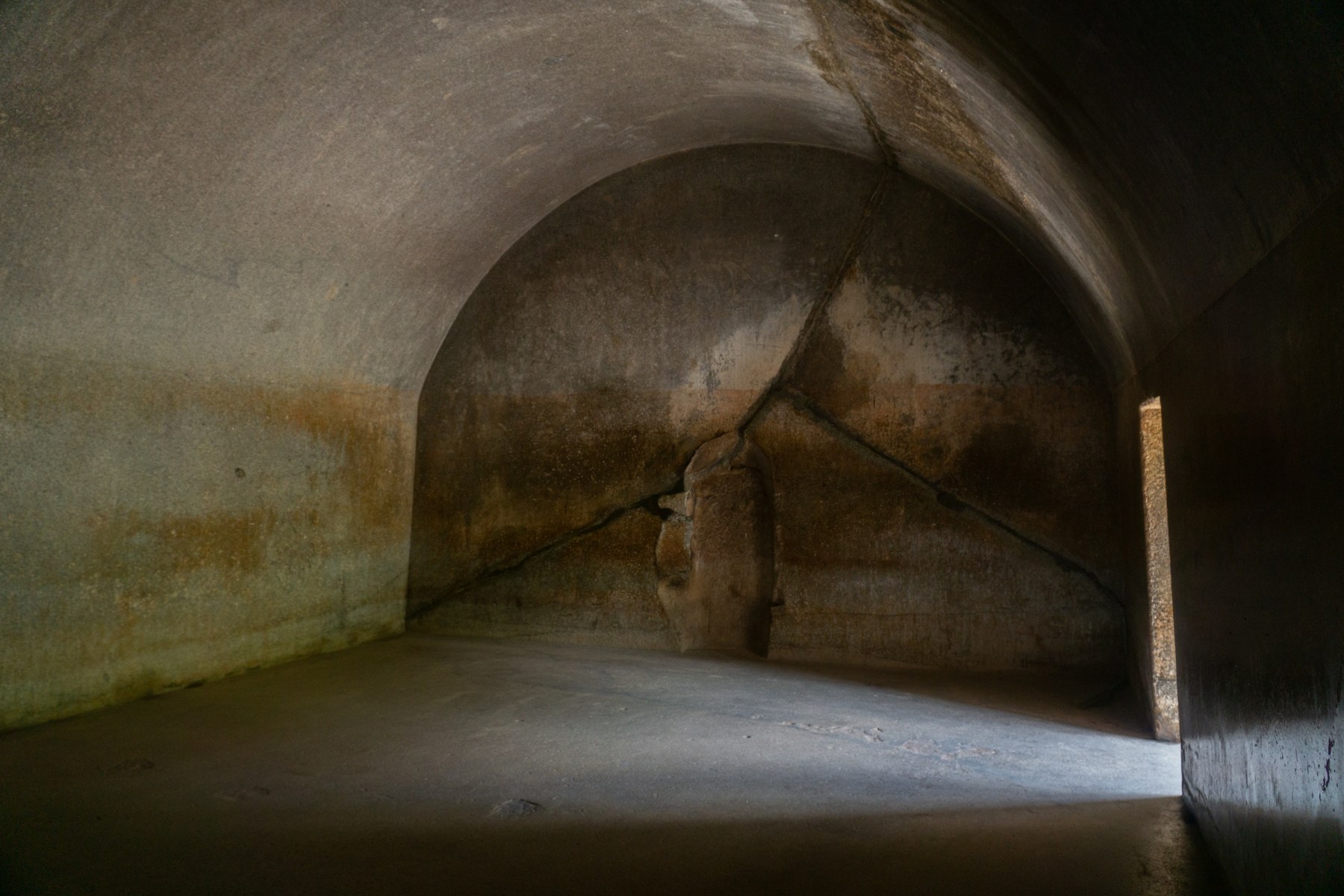
SUDAMA / BARABAR, INDIA
ASI describes two chambers, including a roughly circular inner chamber with a hemispherical vault. Government sources identify carved granite; the third-century BCE inscription records an Ashokan dedication to the Ajivikas.
That gives the site a historical context. It does not support calling it a geopolymer dome. A rock-cut interior has a different structural context from a freestanding shell.
Precise dimensions and a modern-home scale comparison were not independently verified. No special acoustic or technological function is asserted.
ASI Patna: Sudama form and inscription ↗ · Bihar: rock-cut granite context ↗ · Hultzsch: inscription recording Ajivika dedication ↗THE HERO / SACSAYHUAMÁN, PERU
The artwork borrows the visual language of Sacsayhuamán’s closely fitted polygonal masonry and blends it with an imagined mineral specimen. Peru’s tourism inventory describes large carved and assembled stones. Davidovits’s 2021 book introduction proposes extending his artificial-stone interpretation to investigate Sacsayhuamán.
This makes the site a point of curiosity for the project. It does not establish that its walls are geopolymer. The new image is a conceptual composition, not a photograph of the site, a reconstruction of its construction or evidence of an ancient recipe.
Official site description ↗ · Davidovits’s proposed research connection ↗
The 2026 author-posted report interprets a small sample set and field observations as evidence of manufactured stone. Independent peer review was not verified. Broader authorised sampling, geological controls and replication are needed.
Report and limits ↗The 2019 papers propose binders in sandstone and andesite. These are specific disputed interpretations. Natural formation, weathering and contamination remain explanations to test.
Sandstone · Andesite · WeatheringThe artistic connection concerns enduring human needs. Historical communities and archaeological evidence deserve their own context. Modern performance cannot establish how an ancient site was made.
THE MOONSHOT / A PROPOSED RESEARCH PROGRAMME
Connect materials research to the places and people a home depends on—across hurricanes, earthquakes, wildfires and floods.
Dylan proposes testing ancient and historical disaster accounts, geological evidence and local knowledge alongside contemporary observations and models. Records need dating, location, provenance and uncertainty; a gap in a record is not proof that no event occurred.
The ancient casting hypothesis is a separate inquiry. The shape of a monument is not an established way to predict a disaster. Historical analogues also need testing against changing climate, land use and exposure.
Compare predictions with events the model has not seen. Publish uncertainties, missed events, false alarms and useful lead time. Measure whether information actually improves decisions and reaches the people most at risk.
This is a proposed evaluation agenda. No forecasting model was built or validated for this artwork.
UNDRR’s Early Warnings for All programme connects risk knowledge, monitoring and forecasting, communication, and readiness to respond. Its approach supports the project’s emphasis on warnings people can use.
UNDRR: Early Warnings for All ↗USGS distinguishes earthquake probabilities from precise prediction. Earthquake early warning is issued after rupture begins; it may offer seconds before strong shaking in some locations. It does not support days-ahead evacuation claims.
USGS: prediction and early warning ↗NIST’s resilience guide considers buildings, infrastructure, their dependencies and the services communities need to recover. It provides context for investigating whole neighbourhoods alongside individual homes.
NIST: community resilience planning ↗The desired outcome is less displacement and a safe return. That would require evidence about the complete home, contamination, utilities, access and recovery—not only a shell that remains standing. Geopolymer research could contribute; no universal protection or quantified lives-saved benefit is established here.
The neighbourhood illustration imagines every building as geopolymer architecture: domes, courtyard and vaulted homes, three linked modern homes within a flowing enclosure, and a lakeside home with a curling wall. These are artistic proposals. Appearance cannot establish a material’s chemistry, structural performance, carbon footprint or eligibility for construction.
The research agenda covers hurricanes, earthquakes, wildfires and floods. Compare wind and debris exposure, ground shaking, heat and ember exposure, and moving or rising water across buildings, streets, evacuation routes and essential services. The wave wall is one specific water-related question within this wider investigation. Test local risks and interactions rather than assuming one shape addresses every hazard.
The proposed water-facing curve asks whether a building form could redirect approaching waves. Research on recurved seawalls gives a reason to investigate, but does not validate this illustrated home. Pearson and colleagues studied wave overtopping and loading; their complex-wall case also experienced greater impulsive forces than a simple wall. A curve can change the loads as well as the water’s path.
Test the entire proposed system with appropriate hydraulic modelling and physical experiments: overtopping, water levels, loads, erosion around foundations, drainage and effects on neighbours and habitat. Redirecting a wave is different from excluding a rising lake or river. Siting away from danger must remain part of the comparison.
Pearson et al. (2004): recurve walls, overtopping and loads ↗Compare individual and linked homes under the same local hazards. Investigate shared services, fire separation, maintenance, access, affordability and the environmental cost of each form. Landscaping and infrastructure might enable different arrangements, but cannot be assumed to make an unsafe site safe.
For the pictured three-home row, study both the shared enclosure and each dwelling: how connections behave, how residents leave safely, how repairs work, and how privacy and social connection coexist. No engineering design or approval is claimed.
A Pattern Language: Towns, Buildings, Construction (1977) was written by Christopher Alexander, Sara Ishikawa and Murray Silverstein, with Max Jacobson, Ingrid Fiksdahl-King and Shlomo Angel. Its connected scales and participatory approach inspire this project’s question: how could residents, makers and researchers shape a place that feels harmonious while addressing its risks?
Our adaptation asks about shared spaces and landscape at town scale; daylight, privacy and accessibility at building scale; and tested materials, repairable details and learning through prototypes at construction scale. These are contemporary questions for this artwork, not quotations, numbered patterns or an endorsement of geopolymer housing by the authors.
The original book and its authors ↗ · Center for Environmental Structure: participation and building process ↗01 / A REAL-WORLD STARTING POINT
Can we bring the study of resilient buildings together with materials that ask less of the Earth?
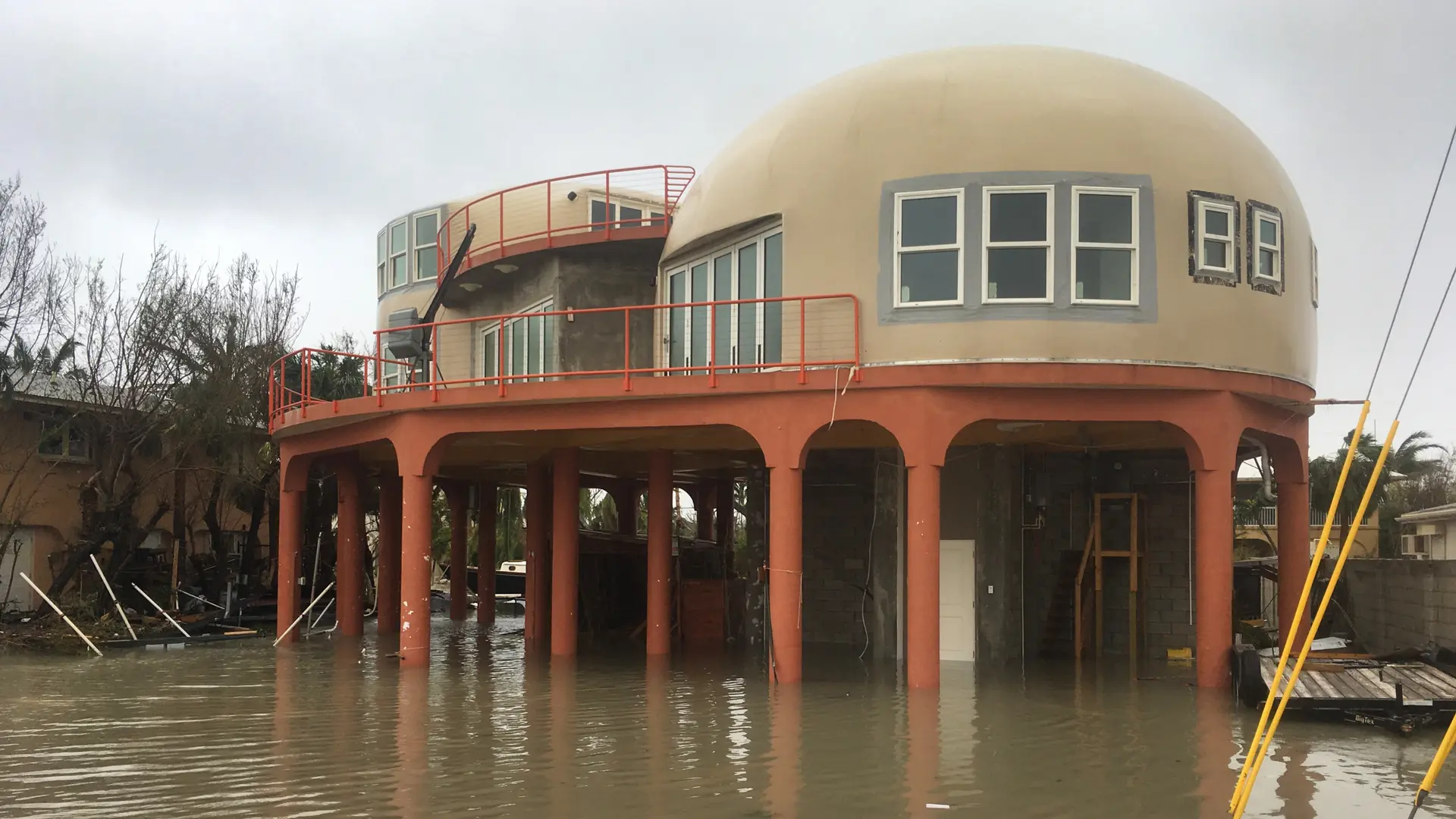
REPORTED CASE / OWNER ACCOUNT
In an account published by Monolithic Dome Institute, the owners reported that their elevated home in Cudjoe Key survived Irma. A small leak occurred at an improperly installed sliding door.
The account is a precedent for inquiry. It does not isolate the contribution of shape, establish geopolymer performance or measure a percentage reduction in structural stress.
A reported outcome makes resilience tangible. It opens questions about the whole building and its particular exposure.
Case account · S12Separate research examines the lifecycle impacts and heat response of specific alkali-activated and geopolymer materials.
Lifecycle research · S5Heat experiments · S6This artwork brings those inquiries together in an imagined mineral home. The combination remains a question for research.
Enter the four environments ↓Pacific Domes: indexed text in its climate-resilience article attributes a 60–70% reduction in structural stress to its Florida domes during 2024 hurricane conditions. We located the published claim, but did not verify an underlying instrument report, comparison method or geopolymer construction. It is recorded as a supplier claim, not used as this artwork’s performance evidence. Source and access note · S13
BBC Future: the supplied article is included as further reading. Its full text was inaccessible during this review, so this exhibition does not use it to verify either the percentage or the material. Open the BBC article ↗
Source review: 16 September 2026.
06 / FOLLOW THE EVIDENCE
What is supported.
What is proposed.
What still needs a test.
The supplied Barndominium Haven video inspired a closer look. The 60–70% statistic is now traceable to a published supplier claim, while its underlying measurements remain unverified. These numerical promises are not demonstrated performance of the depicted shelter. Pacific Domes source note. Reviewed 16 September 2026.
| Claim | Assessment | What the evidence permits |
|---|---|---|
| Geopolymer is real | Supported | A family of inorganic binder materials with real research and applications. Mixes and performance differ; bioceramic products may use other chemistry. |
| Stronger than concrete | Depends on the comparison | Specify the mix, age, curing and property. Compressive strength is not tensile strength, toughness or the performance of an entire building. |
| Noncombustible to 1,382°F / 750°C | Not a whole-building rating | Mineral binders can be noncombustible while cracking, losing strength or transmitting heat. The quoted temperature needs its original test report and duration. |
| 60–70% less structural stress in a 2024 Florida hurricane | Published claim located; measurement unverified | Pacific Domes’ indexed article contains the statistic (S13). No underlying instrument report or comparison method was verified, and geopolymer construction was not established. The number is not presented as a proven benefit. |
| Estimated 500-year life | Unverified estimate | The supplied video itself calls this a manufacturer estimate. It is not a demonstrated service life for a modern home or its windows, seals and services. |
| Food, water and power | Added systems | Greenhouses, rainwater systems, solar and storage can be integrated. They are not intrinsic geopolymer properties, and year-round/off-grid sufficiency needs a local resource budget. |
| Disassemble and relocate | Design-dependent | Requires designed joints, recoverable components, foundations and a practical transport plan. A monolithic shell does not automatically come apart. |
| A cluster is always better than one dome | Not established | Separate modules can isolate uses but add envelope, connections, foundations and land demand. The right layout depends on the programme, site and measured trade-offs. |
| 2026 cost and 30-year savings | Not adopted | No local project scope, contractor quotations or auditable lifecycle model was supplied. Rock Protects Rock makes no cost-saving claim. |
Geopolymers are inorganic binders, commonly based on activated aluminosilicates. Alkali-activated materials form a broader family. “Bioceramic” can describe other chemically bonded ceramics; the terms do not establish identical chemistry or performance.
Research on a specimen, an account of a surviving building, and a manufacturer’s estimate answer different questions. None certifies the imagined home.
Author-posted report; independent peer review not verified
Hawke interprets observations from four labelled fragments associated with two Cusco locations as evidence for artificial stone.
Limit. Small sample set, provenance and comparative controls limit inference. The reported observations do not independently establish a casting process. This is a hypothesis considered by the artwork, not a result produced or endorsed by Rock Protects Rock.
Read the source ↗Materials Letters 235, 120–124; journal article
The authors interpret a Pumapunku sandstone sample, compared with geological materials, as containing an artificial binder.
Limit. A limited sampled context does not establish a site-wide building method. The paper acknowledges that natural and artificial albite cannot be distinguished by the observation alone. Pumapunku is in Bolivia, separate from Cusco, Peru.
Read the source ↗Ceramics International 45, 7385–7389; journal article
The authors report carbon- and nitrogen-bearing material in a sampled andesite fragment, including its interior, and infer an organic-mineral binder.
Limit. The inference requires replication, controlled sampling and chemical characterisation. It must not be presented as established history or as evidence of modern environmental performance.
Read the source ↗Journal of Archaeological Science 40, 1823–1837; journal article
The study examines how weathering and contamination affect stone provenance measurements and comparisons.
Limit. Methodological context only. It predates Hawke's report and is not a direct rebuttal of that report.
Read the source ↗Construction and Building Materials; lifecycle assessment research
Some assessed alkali-activated mixes offer emissions reductions, with results sensitive to constituent manufacture and transport.
Limit. No universal percentage applies to every mix or place. Compare equivalent function, service life, system boundaries, allocation and local supply chains. Alkali-activated materials are a broader category than geopolymers.
Read the source ↗Materials 16, 6065; experimental research
The tested concretes experienced changes and strength losses after elevated-temperature exposure.
Limit. Fire performance is formulation- and exposure-specific. Neither these materials nor the imagined houses in Rock Protects Rock are described as fireproof or floodproof.
Read the source ↗Technical guidance; whole-building and community wildfire exposure
Wildfire resilience depends on linked vulnerabilities, including openings, attached combustibles and neighbouring exposures.
Limit. A noncombustible shell alone does not establish occupant safety or a fire-resistance rating. This guidance does not test the Rock Protects Rock shelter.
Read the source ↗Flood-recovery guidance
Elevation and foundation design are central to reducing flood damage.
Limit. Flood loads, waves, debris, erosion and scour remain site-specific conditions. The optional elevated scene has no calculated pier design or safe flood height; it is not a construction detail.
Read the source ↗Earthquake hazard science
Ground motion, local soil and loss of bearing strength can govern damage.
Limit. Shape and compressive strength alone do not establish seismic performance. Site investigation and engineered reinforcement and connections are needed.
Read the source ↗System design and water-use guidance
Roof collection, storage and treatment can substitute harvested rainwater for some freshwater demand.
Limit. Yield varies with rainfall, catchment, losses and storage; potable use needs suitable treatment. This is an added system, not a geopolymer property.
Read the source ↗Manufacturer description; not independent validation
The company describes its dome material as proprietary chemically bonded ceramics, with a prototype in 2021 and first fully integrated home delivery in 2026.
Limit. Bioceramic is not a synonym for every geopolymer. No manufacturer performance, lifespan, health or environmental claim is transferred to the Rock Protects Rock design.
Read the source ↗Industry case account of a different dome building system
The Tinsleys reported that their elevated dome home in Cudjoe Key survived Hurricane Irma in 2017, with a minor leak at an improperly installed door.
Limit. An owner account published by an industry organisation, not an independent engineering investigation. It does not establish a geopolymer formulation, instrumented stress reduction or general survival rate.
Read the source ↗Supplier article; claim located in search-indexed text; full page returned an access error
The indexed text attributes 60–70% less structural stress to Pacific Domes in Florida during the 2024 hurricane season, compared with neighbouring conventional structures in Category 3 conditions.
Limit. The publication of this claim is traceable. The underlying data, instrument protocol, building sample and comparison were not verified. Geopolymer construction was not established. The number is not adopted as a demonstrated benefit.
Read the source ↗Further reading supplied by the artist; full article inaccessible in this review
Retained as a route for readers to explore reporting on Florida dome homes.
Limit. No technical finding is attributed to the unread article. It is not used here to verify geopolymer composition, the 60–70% statistic or performance of the imagined home.
Read the source ↗Industry project record; building context
Identifies one home made from two Monolithic Domes on an elevated concrete slab, supported by concrete pilings. A conventional structure connects the domes.
Limit. The record supplies building context, not a controlled material comparison or a design specification for this artwork. The exhibition does not describe the home as geopolymer.
Read the source ↗Government terminology; definition located in indexed text; full page inaccessible in this review
Defines pluvial flooding as overland flooding caused by extreme rainfall, separate from a waterway.
Limit. The definition explains why an inland scene is relevant. It does not establish the depicted site’s flood depth, likelihood or appropriate foundation.
Read the source ↗FEMA guidance reproduced by the City of Eugene; material-damage reduction, not a geopolymer test
Flood-damage-resistant materials can reduce water damage and make cleanup easier. The guidance also states that other hazards, such as floodborne debris, remain.
Limit. Material durability does not establish a dry interior, structural survival in every flood or safe occupancy. This source does not test the depicted dome or any geopolymer formulation.
Read the source ↗Official programme guidance
Connects disaster risk knowledge, monitoring and forecasting, warning communication, and readiness to respond. Supports the moonshot emphasis on actionable warnings.
Limit. Does not validate the artwork’s proposed models or imply that every hazard can be predicted in advance.
Read the source ↗Official scientific guidance
Distinguishes earthquake probabilities from precise prediction; related guidance explains that earthquake early warning follows rupture initiation.
Limit. Does not support advance date-and-time prediction or days-ahead evacuation claims for earthquakes.
Read the source ↗Official planning and research guidance
Examines buildings, infrastructure, dependencies and recovery of community functions. Provides context for planning the whole neighbourhood.
Limit. Not a certification of the imagined neighbourhood, its homes or its hazard performance.
Read the source ↗THE WRITING BEHIND THE QUESTION
Independent writing by Dylan Schofield.
Context for the artwork and its questions.
My work in design, technology and visual-effects coordination developed my interest in how complex systems can become understandable. My mortgage and real estate work brings that interest to decisions about homes. These writings connect that experience with my curiosity about ancient construction, material choices and what future generations inherit.
Working paper exploring proposed relationships between material selection, geological sourcing and megalithic architecture. It explains my interest in how material and place might shape shelter.
Unreviewed hypothesis and evidence synthesis. The limitations section acknowledges the small sample and unresolved alternatives.
Read the original preprint ↗A working paper proposing a relationship between ancient sites and mineral resources. It documents an earlier stage of my inquiry.
FNIZ is unvalidated and not peer reviewed. The original subtitle, “Comprehensive Validation of a Chemistry-Specific Ancient Resource Network,” is retained in the publication record; the author’s note above states its present status.
Read the original working paper ↗An essay asking whether architecture might preserve practical instructions. Its proposed interpretation of an ancient site is speculative. The question it leaves me with is contemporary: how can useful building knowledge remain discoverable?
Personal interpretation, not established archaeological history. The article includes third-party footage references and AI-edited imagery, credited in the original.
Read the original essay ↗These publications explain why I began. The material research and building case studies elsewhere in this notebook have separate sources and limitations. Views and downloads are not scientific validation.
Download the personal note ↓ · Download the research companion ↓
Return to the personal story ↗Concept and creative direction: Dylan Schofield.
2026 · Digital art, film and research.
Rock Protects Rock began with an interest in enduring ancient buildings and the homes future generations will inherit. It asks whether material innovation can connect human shelter with less harm to the living world.
The imagined architecture and film use generative imagery, a consistent synthetic stock narrator, original sound design and AI-assisted writing, research and implementation. Dylan supplied the concept and creative direction.
No physical installation, material test or engineering validation was performed. AI-generated illustrations and concept imagery are identified as such; they do not document fieldwork. The research notebook also includes credited documentary photographs by other creators, with source and licence links beneath each image.
